|

Houseboats
and Shikaras
Srinagar, Kashmir
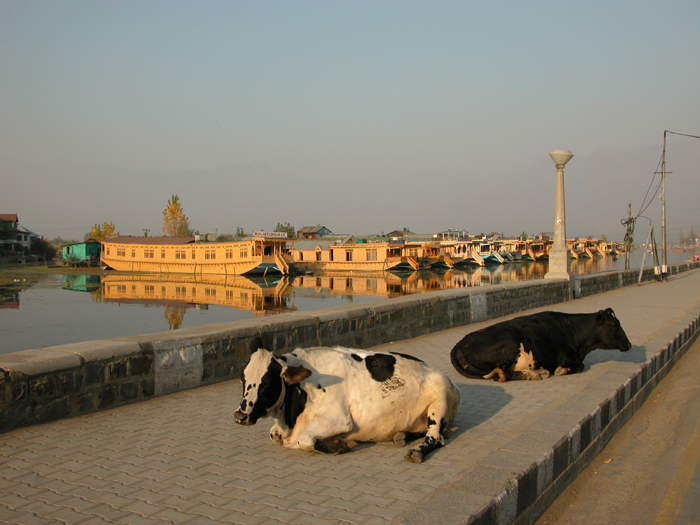
Dal Lake with the houseboats
or "floating palaces"
which are so famous for this area
|
The Houseboat Tradition |
| In the 19th century the
English boat-dwelling community in Srinagar startet
building luxury versions of their own homes to cater the demands of the
many visitors. In those days the settlers were not allowed to buy land in Srinagar and the
houseboat tradition developed. The houseboats carry names like "H.B.
Duke Well", "Silver Stereet", "New Pala Palace" which clearly refers to
the English settlers.
This has during time developed into a well organized houseboat hotel
business, where you can rent a room or a whole boat. Many Indian
tourists stay here in the summer, as the climate is plesant and the
surroudings offer many possiblities for interesting seightseeing.
Srinagars over thousand houseboats are moored along sections of
Dal and Nagin Lakes and the Jhelum River. Each are decorated fancifully
and given romantic names. Like hotels the houseboats vary in degree of
luxury and are rated according to the facilities.
Foreign tourists are few because of the political situation.
Foreigners are adviced to stay in the houseboats, where an owner and his
famil can look after you. The hotels along the lakeside boulevard are
considered insecure.
Summer is high season because of the cooler climate than in the
Indian peninsula. Autum are cold. The winter temperature can go down to
minus 10 degrees celcius. The lake will be frozen and snow covers the
landscape.
|
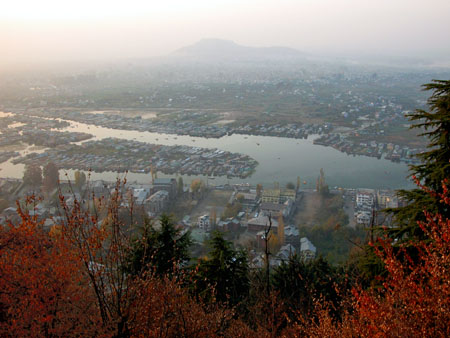
Dal Lake in autumn colours with houseboats side by side,
seen from the Shankaracharya Hill,
"Takht-i-Sulaiman" or the "Throne of Solomon"
|
Shikaras, "The Gondols of Srinagar" |
|
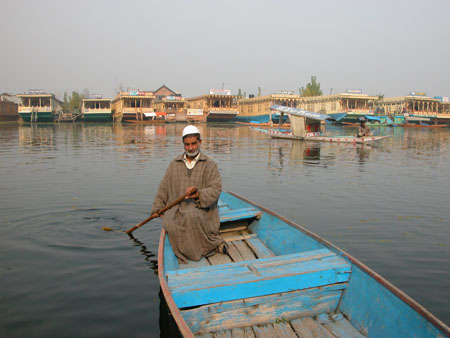
Riding Sikhara - a very special way of life on Dal Lake
|
| Shikaras, the Kashmiri canoes, is
a nessessary means for transportation, as
the river Jhelum (or Vitasta) runs through the city and lakes covers large
parts of Srinagar and it's surroundings. Vendors offering all kinds of
goods, are on the lake all day long. As a tourist it can be difficult to
go
anywhere without being followed by several boats. You may work out an agreement with your host to protect you
from the vendors, so you can enjoy your stay.
The Shikaras used for
boatrides are made of Deodar wood and highly decorated with cusions,
curtains and other romantic equipment. They offer a very
comfortable ride on the beautiful lakes.
It is a fairly well known
fact, that Jewish tribes has settled in this area long before the birth
of Christ. Kashmir was considered the real "Paradise on Earth", "The
Promised Land" - "The Land of Milck and Honey".
Some of the
boatmen, the Hanjis, who are living in Shikaras, Doongas and houseboats on these lakes,
even claim they are descendants of the Jewish patriarch, Noa. |
|
Houseboat Rooms
for Rent ... |
|
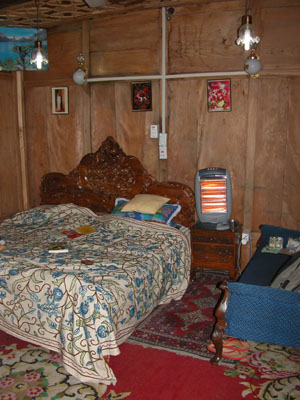
A budget room in a houseboat
Every houseboat has
a balcony in the front. A lounge and diningroom where you can spend time
with the host family or other guests. several bedrooms with attached
bathroom and a pantry. The price includes all meals of the day and free
rides to and from the nearest Ghatt, (bank or jetty).
The hospitality is
very high though and the Kasmiris take great pride in making their
guests feel at home and provide everything you may need. You're reminded
that you should feel at home as long as you stay in their boat.
"Beeing in Srinagar
in the autumn, it was freezing cold when I was supposed to go to bed.
Creativity was needed here, as the bed was not what I normally use. Four
heavy wollen blankets in colourfull patterns, and a piece of curtain on
the matress. Good idea to keep your clothes on! The heat was centered
around the electric heater and reached only 1 meter into the room. So
your head was not kept cold and the feet warm. It was the opposite!
That's probably why the Kashmiris wear long woollen coats and as uncle
Haji showed me they keep glowing charcoal in an iron basket underneath!
I got my sleep. And it was needed as it turned out that the next day was
one long drive to find the
Grave of Moses
in "the reddish mountains",
the Rod of Christ in Aish Muquam etc. etc.
Next day, coming
back from these maginificient places, I noticed some cake crumbs right
next to my suitcase. I opened it thinking it was mice. It turned out,
that the children in the family, entering from the window, had been
searching for goddies in my room, without touching anything else!
I
let Uncle Haji know, I had noticed it and he looked a little baffeled,
the funny fox-like houseboat owner became unusually silent. It's
difficult to know who lives in the boat. When I left, I gave my new map
over India to Uncle Haji to decorate the lounge, to the greatest
dissapointment to Farooq, my guide who, along with a freind, had driven
me all over Kashmir and hadn't left my side for the three days, I stayed
in Srinagar."
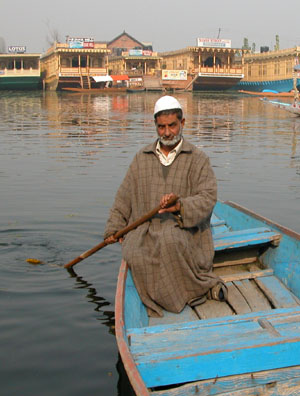
"Uncle" Haji Khazir Mohammed
owner of the three boats seen in the background |
|
The Houseboat Owners Association |
|
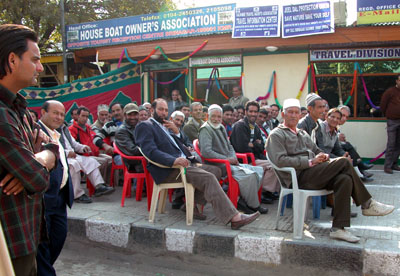
Meeting in The Houseboat Owners Association
at the office in Srinagar
|
|
The houseboat business is very well organized.
The owners pick you up in the airport, at tourist offices or other
places.
Each boat owner gets their customers after a carefully worked out plan,
to ensure that every houseboat owner gets a share of the incoming
tourists.
The owners have won
praise all over the world for being professional guides and trekkers.
They also undertake local sightseeing tours, trout fishing, trekking and
other activities.
Visitors can also
themselves reserve a houseboat at the office of the Houseboat Owners
Association or in Srinagar Int. Airport. |
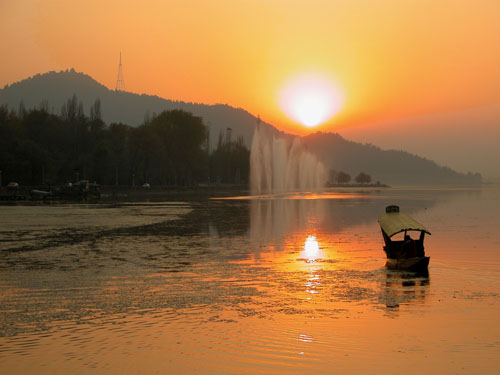
Sunset over Dal Lake with Shankaracharya Temple Hill in the background
|
Litterature:
Hassnain, Fida M. A Search for the
Historical Jesus, Gateway Books, U.K., 1994 - ISBN
0946551
99 5
Kashmiri, Aziz,
Christ in Kashmir, Roshni Pubs, Srinagar, 1984
Kersten, Holger,
Jesus Lived in India, Element, Shaftesbury, UK, 1986
Bock, Janet, The Jesus Mystery, Aura Books, Los Angeles, 1980
Hazrat Mirza Ghulam Ahmad of
Qadian, Jesus in India, 1989
Read more about "Jesus in India":
http://en.wikipedia.org/wiki/Jesus_in_India_(book)
The lost Years of Jesus:
http://en.wikipedia.org/wiki/Jesus_in_India#Jesus_in_India
|
|
mukti4u2@gmail.com |
 |
www.mukti4u2.dk |
mukti4u2.dk
► created by
BP |